Overview
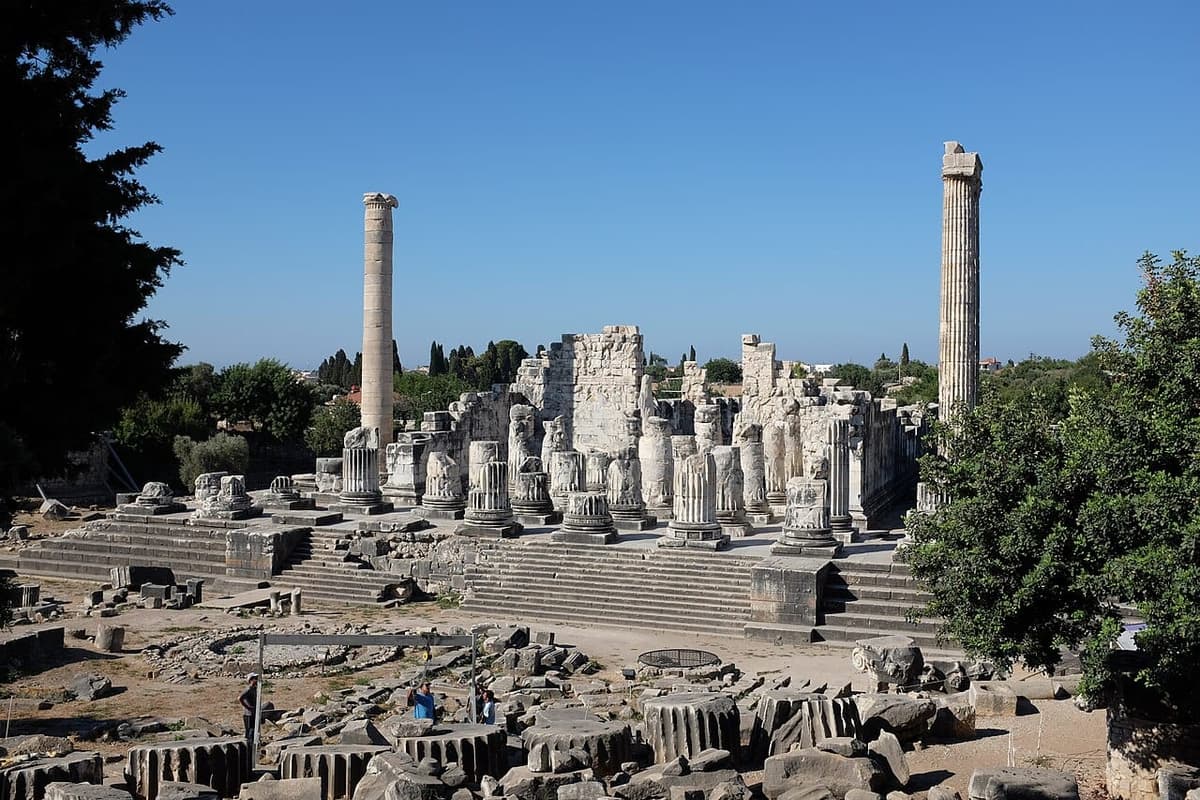
Located on the western coast of Anatolia, near the modern town of Didim, the archaeological site of Didyma was not a city but a sacred sanctuary, part of the great Ionian cultural sphere and administratively linked to the nearby polis of Miletus. Its core is the awe-inspiring Temple of Apollo, the Didymaion, a colossal structure that ranks among the largest and most ambitious Greek temples ever conceived. Built on a vast raised platform, its ruins still convey staggering scale: the temple was dipteral, with a double colonnade of 120 enormous Ionic columns, each standing nearly 20 meters high. Ten of these giants remain upright today. The sanctuary was approached via a monumental sacred way from Miletus, leading to a grand staircase. Unusually, the temple was hypaethral (open to the sky), with a small inner shrine, or naiskos, nestled within a vast, walled courtyard accessible through a towering portal. This architectural complexity, alongside the famous oracular spring and sacred laurel grove within the adyton, created a dramatic setting for prophecy.
Didyma's historical significance stems from its role as one of the most revered oracular centers of the ancient Greek world, standing alongside Delphi and Claros. The oracle of Apollo, delivered by a priestess (the prophetess) who would utter responses while in a trance-like state, guided colonists, influenced political decisions, and drew pilgrims, rulers, and city-states from across the Mediterranean seeking divine counsel. The original Archaic temple was destroyed by the Persians in 494 BC, but the oracle continued in a diminished capacity. Its greatest revival came after Alexander the Great's conquest, when he liberated the sanctuary, and the construction of the present Hellenistic temple began under the Seleucid kings around 300 BC. Work continued for centuries under Roman patronage but was never fully completed, leaving parts of the column drums unfluted and the temple without a conventional roof.
"The temple of Apollo at Didyma is the largest and most magnificent of all temples in Ionia."
— Strabo, Geography (c. 20 CE)
Key structures beyond the main temple include the remains of the lengthy Sacred Way, lined with statues of seated priests and priestesses, which connected the sanctuary to Miletus. Within the temple precinct, one finds the well-preserved foundations of a smaller Temple of Artemis, sister to Apollo. The heart of the oracular ritual was the adyton, a sunken, labyrinthine chamber beneath the temple's eastern porch, accessible only to the priests, which housed the sacred spring. A narrow, vaulted tunnel connected this inner sanctum to the naiskos, allowing the prophetess to descend and the priests to process. The temple's walls and even the column bases are covered in intricate inscriptions and graffiti, including detailed construction accounts and the so-called "oracle texts," providing invaluable insight into its administration and function.
The cultural context of Didyma is deeply rooted in the Ionian Renaissance, a period of immense intellectual and artistic flourishing in western Anatolia. The sanctuary was a central religious and cultural node, its grandeur a statement of Milesian prestige and Hellenistic ambition. The ongoing, centuries-long construction project itself became a form of devotion and a source of local identity. While fundamentally Greek in its deity and practice, the site's deep Anatolian location suggests it may have succeeded an earlier local cult, a common syncretism in the region. Under the Roman Empire, Didyma maintained its prestige, with emperors like Trajan and Hadrian consulting the oracle, ensuring its role as a potent symbol of pagan tradition until its final closure by Christian decree in the late 4th century AD.

Didyma Map | Hekataios von Milet (CC BY-SA 4.0)