Overview
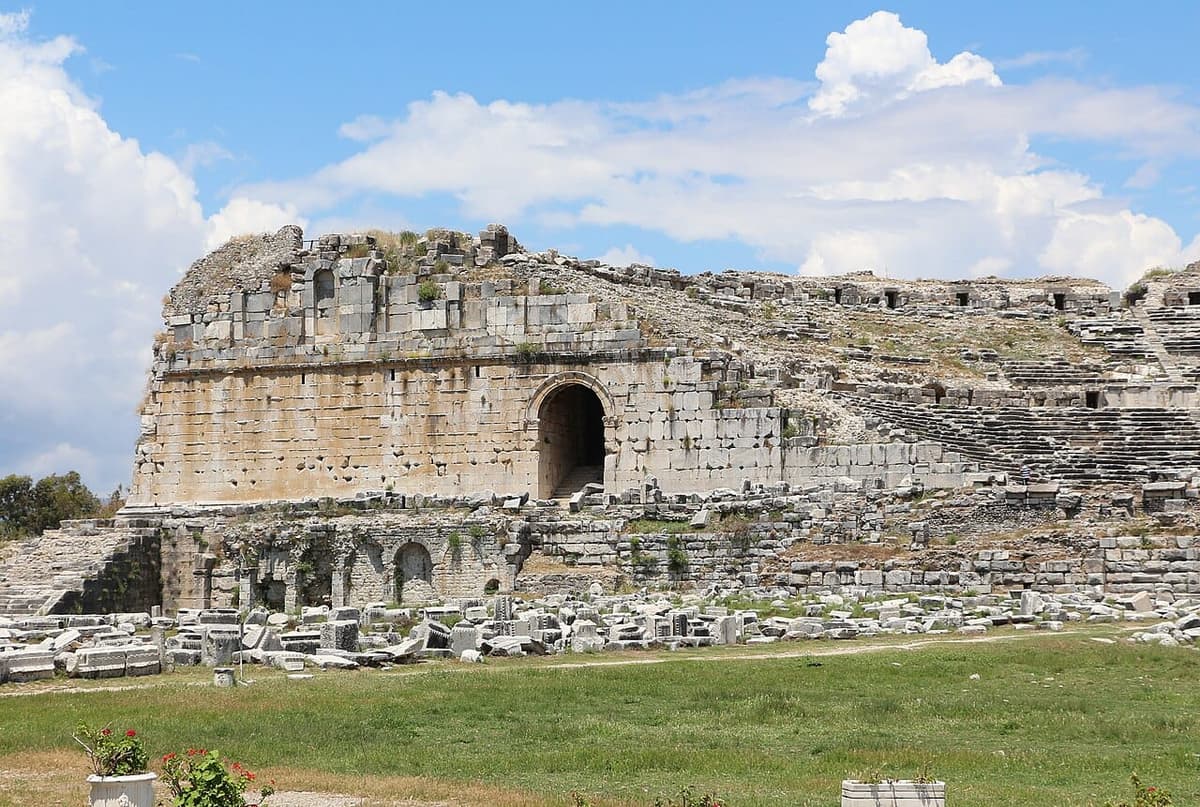
Nestled on the alluvial plains of the Maeander River, the archaeological site of Miletus presents a striking, if somber, landscape. Once a prominent peninsula on the Aegean coast, centuries of silt deposition have left its monumental ruins stranded several kilometers inland, surrounded by marshy terrain. The site is dominated by the remarkably well-preserved Hellenistic theatre, carved into a hillside, which could seat approximately 15,000 spectators and was later expanded under Roman rule. Beyond it, the sprawling remains reveal a city rigorously laid out on a grid plan, a revolutionary design attributed to the architect Hippodamus after the city's destruction in 494 BCE, making it a seminal model of urban planning for the ancient world.
Historically, Miletus was one of the most powerful and influential of the twelve Ionian cities. Its significance extends far beyond its political and commercial prowess, as it was the vibrant epicenter of the Ionian Enlightenment. In the 6th century BCE, it became the birthplace of Western philosophy and scientific inquiry with the Milesian School, founded by Thales, and continued by his pupils Anaximander and Anaximenes. These thinkers sought natural, rather than mythological, explanations for the cosmos, fundamentally shaping intellectual history. The city's maritime strength was legendary, founding numerous colonies across the Black Sea and the Mediterranean, before its pivotal role in the Ionian Revolt led to its sack by the Persians.
"Miletus, the greatest of Ionian cities, was founded by Neleus, a Pylian by birth."
— Herodotus, c. 440 BCE
Key structures at the site chronicle its long habitation from the Neolithic period through Byzantine times. The massive theatre remains the most iconic landmark. Before it lies the extensive Baths of Faustina, a grand complex built in the 2nd century CE and gifted by Emperor Marcus Aurelius' wife, featuring towering walls and elaborate vaults. The Sacred Way, a processional road flanked by stoas, leads from the city's southern harbor to the sanctuary of Apollo at Didyma. Other significant ruins include the sprawling Ionic-style Bouleuterion (council house), the Delphinion (a sanctuary to Apollo Delphinios), and the formidable city walls, whose scale testifies to Miletus' enduring importance.
Culturally, Miletus embodied the dynamic synthesis of Greek and Eastern influences characteristic of Ionia. Its wealth, derived from trade in wool, textiles, and maritime commerce, fostered a sophisticated urban culture. The city was a major center for the arts, particularly sculpture, with its own distinctive school. The grid plan of the rebuilt city, dividing public and private spaces with geometric precision, reflected a new, rational approach to civic life and social organization that would be exported across the Hellenistic world. As a bustling port and intellectual crossroads, Miletus served as a critical conduit for ideas, goods, and cultural exchange between the Greek world and the civilizations of Anatolia and the Near East.

Miletus archaeological site (1) | Radosław Botev (CC BY 3.0 pl)