# The World's First Temple: What Göbekli Tepe Rewrote About History
A Shepherd’s Chance Discovery
"First came the temple, then the city."
Klaus Schmidt, Excavation Director (1995-2014)
In the autumn of 1994, on a windswept, barren hilltop in southeastern Turkey, a shepherd named Şavak Yıldız noticed something odd. His sheep were scattering around a patch of ground where a single, partially exposed stone protruded from the earth. It was not a natural rock. Its edges were straight, its surface smooth. Unknowingly, he had stumbled upon the tip of a monolithic iceberg, a discovery that would soon force a fundamental rewrite of human history. That hill, known locally as Göbekli Tepe (“Potbelly Hill”), would within a decade dismantle long-held certainties about the origins of civilization.
For decades, the prevailing narrative of human societal development was linear and seemingly logical. The Neolithic Revolution — the shift from nomadic hunting and gathering to settled farming — was thought to be the catalyst for everything that followed. According to the textbook, it was only after humans mastered agriculture, securing a stable food surplus, that they had the luxury of time, resources, and social organization to build monumental architecture, develop complex religions, and create stratified societies. Temples, we were taught, came after cities. Religion was a product of surplus.

Unique engraving of a female on a stone slab from Göbekli Tepe, Urfa Museum | Emre Deniz Yurttaş (CC BY 4.0)
Göbekli Tepe, with its staggering radiocarbon dates circling **9600-8000 BCE, shattered that sequence. Here was the world’s oldest known megalithic architecture, built by prehistoric people who, by all traditional definitions, should have been simple hunter-gatherers. They had no pottery, no metal tools, no domesticated wheat, and no permanent settlements — at least none we have found nearby. Yet, they quarried, carved, and erected pillars weighing up to 20 tons, arranging them into vast, ritualistic enclosures. They did not build a village that needed a temple; they built a temple that may have necessitated a new way of living. This is the Göbekli Tepe paradox, and it is rewriting our story from the ground up.
The Architecture of the Ancients: Pillars of a New Belief
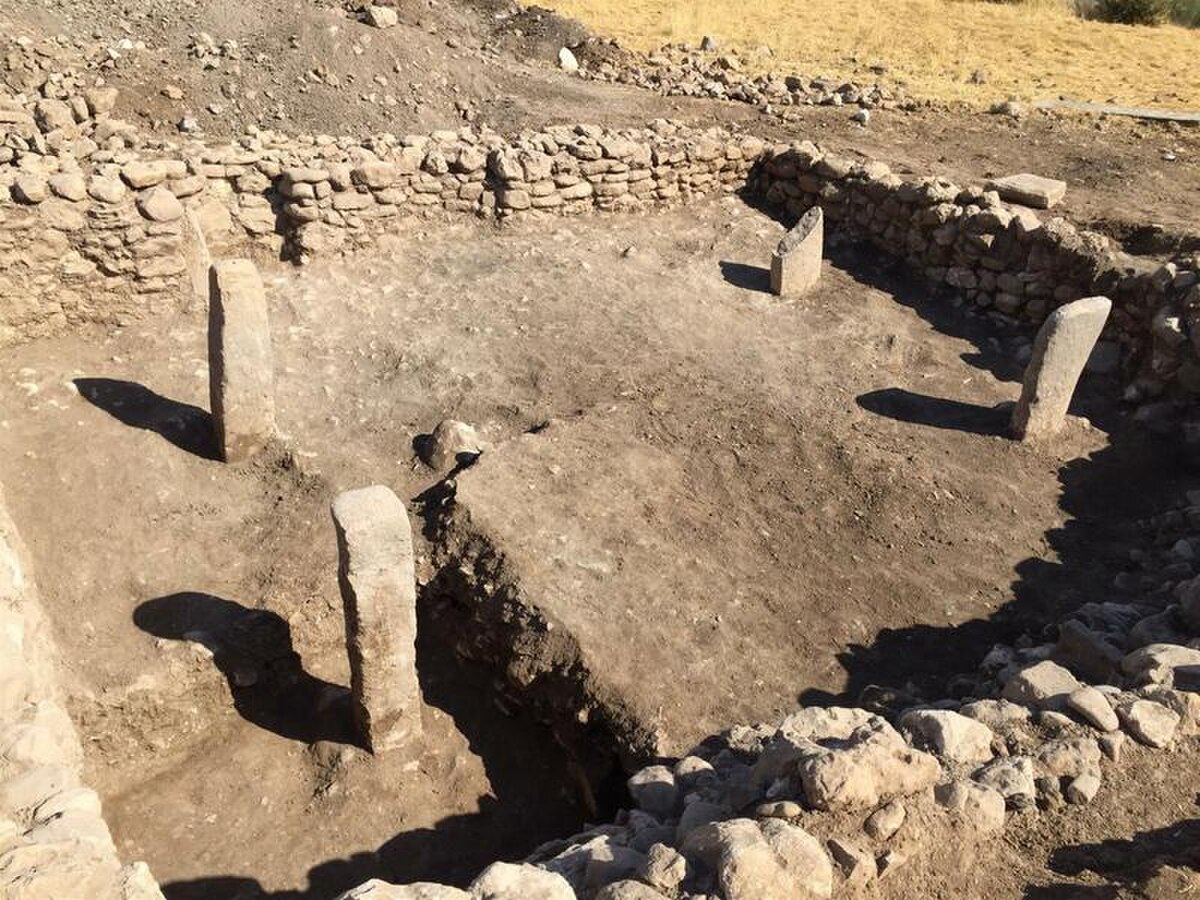
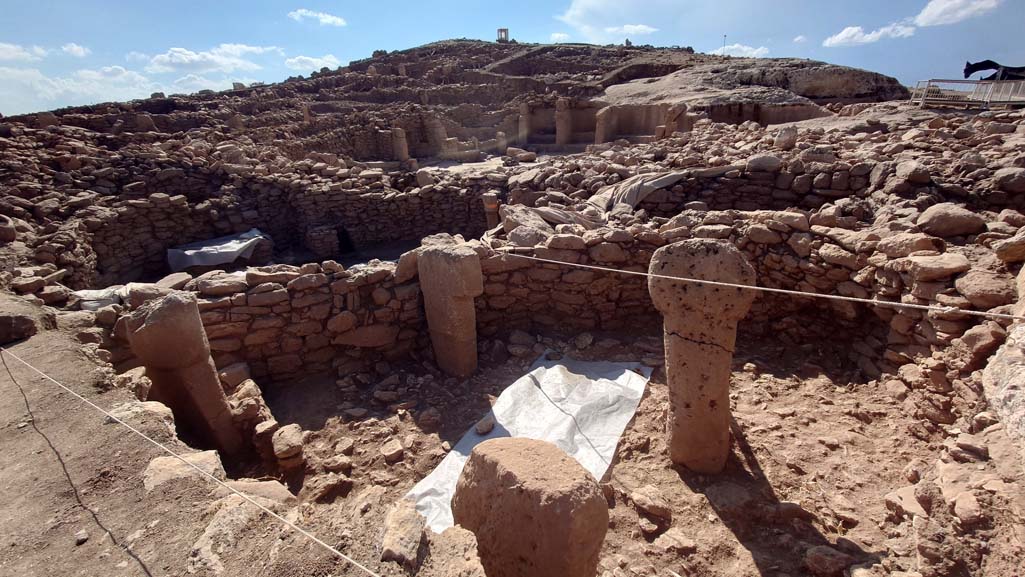
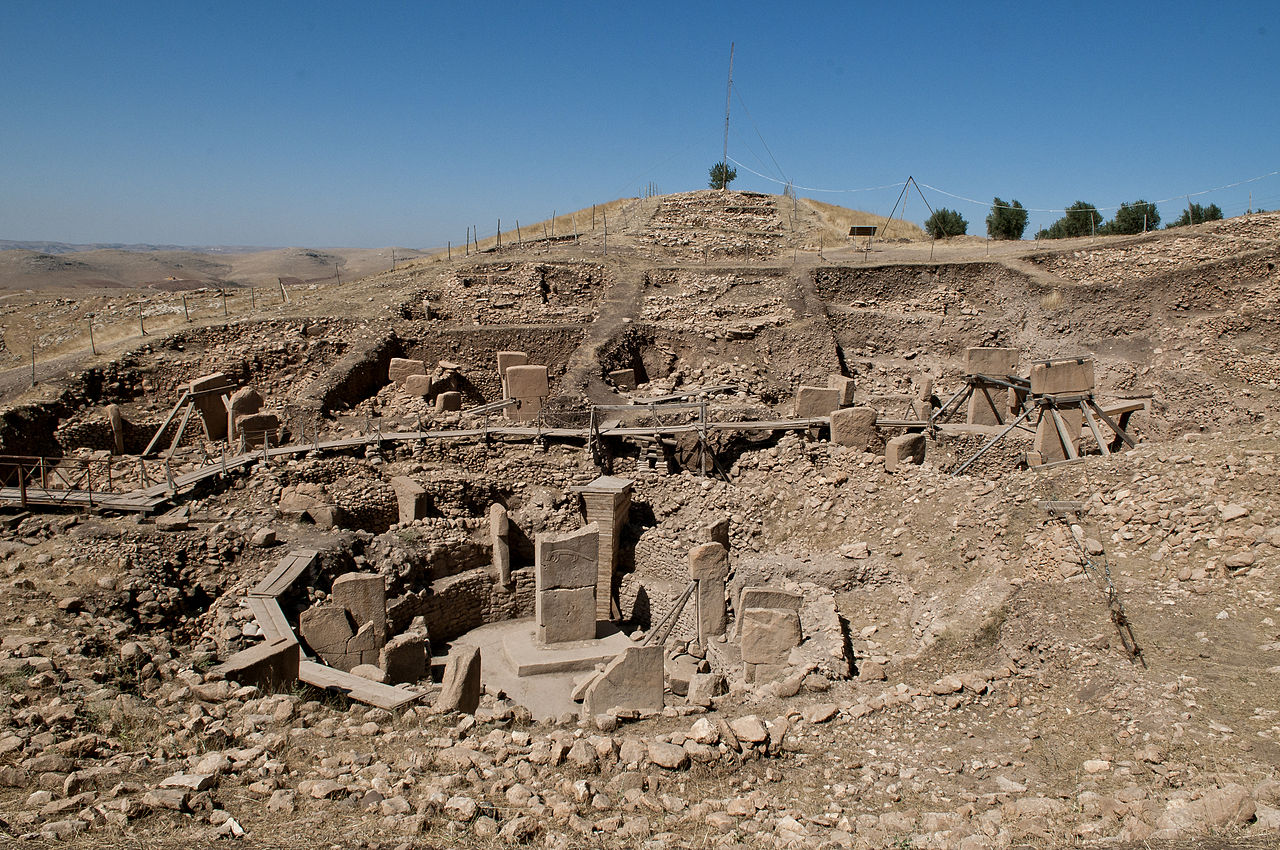
Excavations led first by German archaeologist Professor Klaus Schmidt of the German Archaeological Institute (DAI) from 1995 until his death in 2014, and continued by his successors, have revealed a site of breathtaking complexity and scale. Göbekli Tepe is not a single structure but a series of at least 20 circular and oval enclosures, built on the hill’s bedrock.

Gobekli Tepe Building F in 2014 3208 | Dosseman (CC BY-SA 4.0)
Each enclosure is defined by a ring of towering T-shaped limestone pillars, with two even more massive pillars set in the center. These T-shapes are now understood to be highly stylized human forms. The “head” of the T is the head; relief carvings on some “shoulders” depict arms, hands, and items of clothing like belts and loincloths. They are silent, stoic beings, perhaps ancestor spirits or gods, gazing inward over the ritual space.
The imagery carved into these pillars is a menagerie of the Pre-Pottery Neolithic world, frozen in stone. A dizzying array of animals — foxes, boars, cranes, snakes, scorpions, lions, bulls, and ducks — cover the surfaces. These are not peaceful pastoral scenes; they are dynamic, often dangerous creatures. The symbolism is profound and debated: are they totemic clan symbols? Protectors? Representations of a vibrant mythic cosmos? Or warnings? The sheer density of carving suggests a sophisticated symbolic language, a shared belief system powerful enough to coordinate labor across a wide region.
Most astonishing is the builders’ final act: around 8000 BCE, they deliberately and meticulously buried the entire complex. Thousands of tons of soil, stone tools, and animal bones were hauled up the hill to fill the enclosures, sealing them for millennia. This was no act of destruction, but one of preservation — a ritual entombment of a sacred place whose purpose had been fulfilled or transformed. This act of burial is what saved Göbekli Tepe for us, protecting the carvings from erosion and later settlement.

Göbekli Tepe, Urfa | Teomancimit (CC BY-SA 3.0)
The Social Engine: Hunter-Gatherers as Master Builders
If these people weren’t farmers, how did they achieve such a feat? This question gets to the heart of Göbekli Tepe’s revolutionary impact. The archaeological evidence from the fill layers is clear: the bones are from wild game (gazelle, aurochs, wild ass); the plant remains are from wild cereals. These were hunter-gatherers, but likely of a type we are only beginning to appreciate.
Göbekli Tepe did not exist in a vacuum. It was a regional cult center. The labor required — quarrying multi-ton pillars from local bedrock using stone tools, transporting them hundreds of meters, carving them, and erecting them — would have required hundreds of workers. This implies a level of social organization, coordination, and leadership previously deemed impossible for pre-agrarian societies. It suggests that different hunter-gatherer groups, perhaps scattered across the fertile plains of Upper Mesopotamia, came together seasonally at this central, sacred location.
What did they eat during these large gatherings? The theory proposed by Klaus Schmidt and supported by many is the “Feasting Hypothesis.”* Groups would converge, bringing with them food from their territories. The massive amounts of animal bones (over 100,000 gazelle bone fragments have been identified) point to large-scale, ritualized consumption. It was in this context of communal ritual and feasting, Schmidt argued, that the need to feed large, regular gatherings may have driven* the domestication of plants like einkorn wheat and animals like the pig. In this new narrative, the temple didn’t come from the farm; the farm may have come from the needs of the temple.
The Greater Tapestry: Karahantepe and Boncuklu Tarla
The story has grown even richer in recent years. Göbekli Tepe is no longer a solitary anomaly but the star in an emerging constellation of contemporaneous sites, part of what Turkish archaeologists now call the “Taş Tepeler” (Stone Hills) project.
Just 35 kilometers to the southeast, the site of Karahantepe is undergoing dramatic excavation. Dating to the same Pre-Pottery Neolithic period, it reveals a similar megalithic culture but with striking new dimensions. Here, archaeologists led by Professor Necmi Karul have uncovered over 250 T-pillars, many still in situ within the bedrock, suggesting the site was carved downward into the limestone plateau. The artistry is even more pronounced. Karahantepe features stunning three-dimensional sculptures: a human head with pronounced cheekbones and a serious expression, and a dramatic pillar depicting a human figure holding what appears to be a phallus in one hand and a leopard under the other arm. The site reinforces the scale of this cultural phenomenon and suggests regional variations in ritual and iconography.
Meanwhile, at Boncuklu Tarla, near the modern city of Mardin, excavations have provided a crucial missing piece: the domestic. Dating back to **12,000 BCE — even earlier than Göbekli Tepe — this site shows a long-term settlement of hunter-gatherers living in round, wattle-and-daub houses. Crucially, within this village context, they built small, special structures with stone foundations and benches, interpreted as the earliest known village shrines. Boncuklu Tarla acts as a vital bridge, showing that ritual architecture began at a small, community level before evolving into the monumental, regional projects of Göbekli Tepe and Karahantepe. It shows a gradual development of ritual space, from house to shrine to temple complex.
Rewriting the Human Story: A Paradigm Shift
The implications of these discoveries in southeastern Turkey are profound. They force us to abandon the simple, economic determinism of the old Neolithic narrative.
- Complexity Before Agriculture:* Monumental architecture, sophisticated symbolic art, and large-scale social organization are now proven to have existed prior* to domestication. The human capacity for collective, non-utilitarian projects is far older than we thought.
- **The Primacy of the Ideological: The driving force behind this leap in social complexity may not have been material need (food surplus), but ideological and social need — the human desire to come together for ritual, to create a shared cosmology, and to mark a sacred place in the landscape. Belief, it seems, built the first temple.
- A New Cradle of Civilization:* While Mesopotamia’s Uruk and Sumer remain the cradle of urban civilization, the hills of Anatolia are now firmly established as the cradle of symbolic and monumental* civilization. The roots of everything that followed — organized religion, social hierarchy, skilled craftsmanship — are being traced back to these stone circles.
- The Question of “Why Here?”: The Urfa region sits at the northern edge of the Fertile Crescent, an area rich in wild ancestors of domesticated plants and animals. It was a resource-rich, ecologically diverse zone that could support dense populations of hunter-gatherers. This abundance may have provided the stable base from which such complex cultural experimentation could spring.
The Unanswered Questions and the Future
For all it has revealed, Göbekli Tepe and its sister sites guard their secrets closely. Who were the people who carved these pillars? What specific rituals were performed in the enclosures? What was the meaning of the animal symbols and the central, anthropomorphic pillars? The absence of obvious residential structures at Göbekli Tepe itself remains a puzzle — did the builders live in temporary camps on the slopes, or in settlements yet to be discovered in the surrounding plains?
The most tantalizing question of all lingers: What knowledge was lost when these sites were buried 10,000 years ago? The deliberate interment suggests a conscious end to an era, a closing of a spiritual chapter before the world turned toward agriculture, villages, and a new, more familiar kind of society.
As the Taş Tepeler project continues, with a dozen more sites slated for investigation, one thing is certain: the story is not complete. Each new trench, each newly uncovered pillar, has the potential to further upend our understanding. Göbekli Tepe taught us that our ancestors were far more capable, imaginative, and spiritually driven than we had ever credited them for. It stands as a monumental testament not to kings or empires, but to the power of shared belief to move mountains — or, in this case, to carve them from the earth and raise them to the sky. The first temple reminds us that long before we built cities, we built meaning, and in doing so, we began the long, winding journey to who we are today.