# From Hattusha to Troy: The Hittite Empire's Rise and Fall
Prologue: A Forgotten Empire Resurrected
"The Sun-goddess of Arinna is queen of all lands. In the land of Hatti she bears the name Sun-goddess of Arinna."
Hittite Prayer Text (c. 1400 BCE)
For over three millennia, the Hittites existed only as a ghostly echo in the pages of the Bible and fragmentary Egyptian records — a shadowy kingdom of the north. Then, in the late 19th and early 20th centuries, the spade of the archaeologist began to exhume a lost superpower. At a windswept site in central Turkey called **Boğazkale, German archaeologist Hugo Winckler, deciphering clay tablets inscribed with a strange, wedge-shaped script, made a staggering declaration in 1906: this was Hattusha, the capital of the mighty Hittite Empire. Suddenly, a vacuum on the historical map was filled with a vibrant, complex civilization that rivaled Egypt and Babylon. This is the story of that empire’s meteoric rise from the Anatolian plateau, its century-spanning dominance, and its mysterious collapse that sent shockwaves from the citadels of Troy to the gates of Egypt.
Foundations in the Land of a Thousand Gods: Hattusha and Alacahöyük

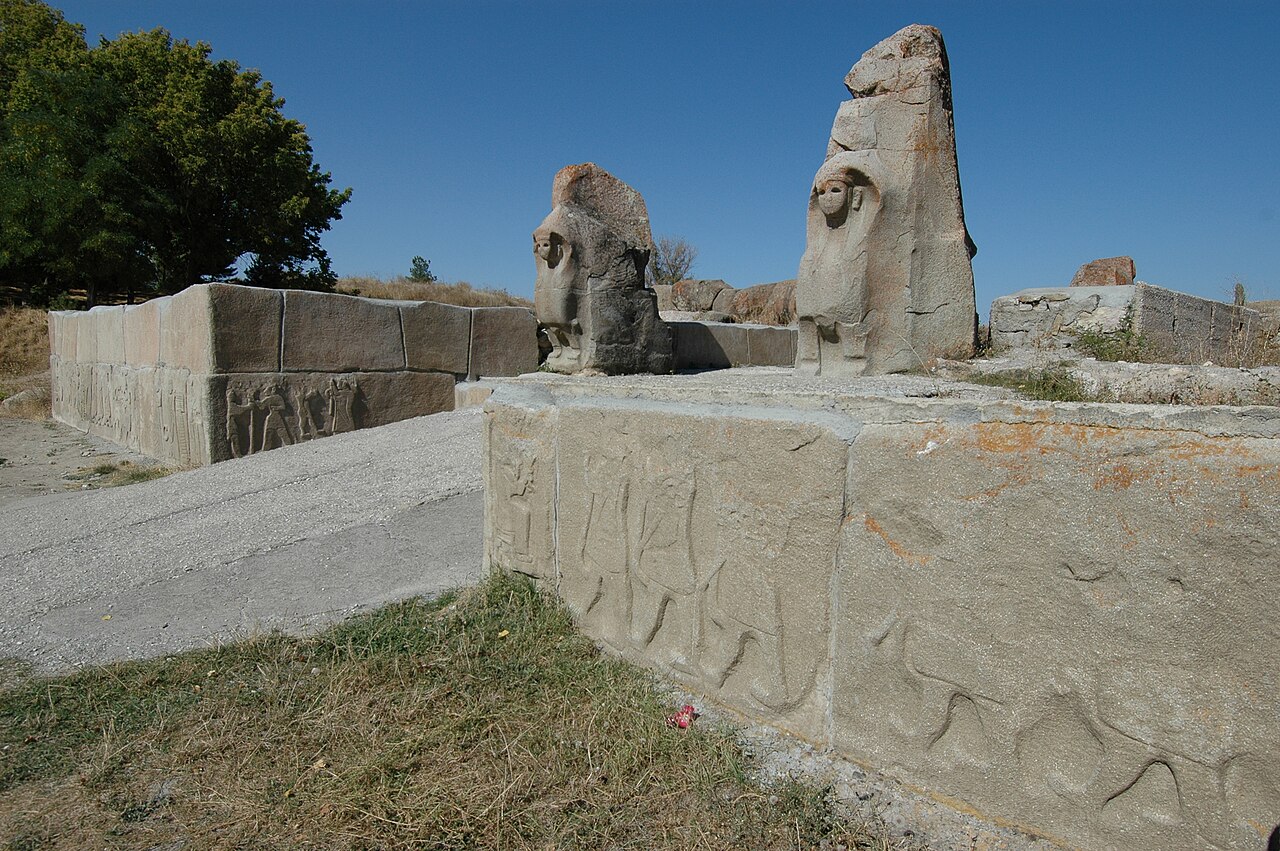
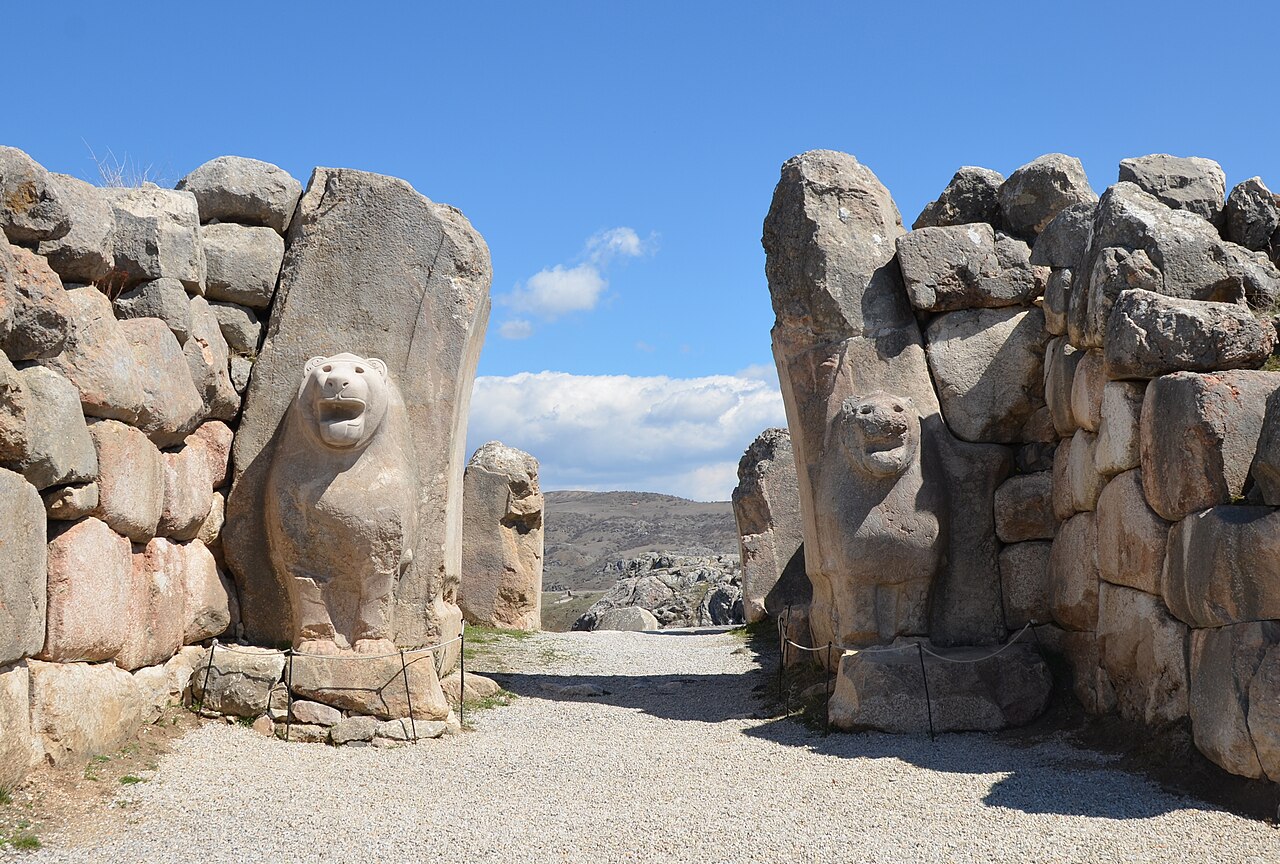
Lion Gate, Hattusa 01 | Bernard Gagnon (CC BY-SA 3.0)
The Hittite story begins not with the Hittites themselves, but with the Hattians, an indigenous people of central Anatolia. Their spiritual and cultural heartland is glimpsed at Alacahöyük, a site inhabited since the Chalcolithic period. By the Early Bronze Age (c. 2500-2000 BCE), Alacahöyük was a wealthy princely center. Its royal tombs, discovered in the 1930s, revealed staggering funerary goods: sun discs and stag statuettes of solid gold, electrum, and bronze; sophisticated weapons; and elaborate jewelry. These artifacts speak of a powerful, stratified society with deep artistic and religious traditions centered on solar and stag deities.
Into this world, around 2000 BCE, came speakers of an Indo-European language — the Nesili, or "people of Nesa." We know them as the Hittites. They absorbed, adapted, and eventually superseded the Hattian culture. Around 1650 BCE, King Hattusili I made a decisive strategic move. He abandoned the old capital at Kussara and established his seat of power at Hattusha, a dramatic, mountainous site with natural defensive advantages. This was not just a political act; it was a spiritual conquest, taking the name of the land (Hatti) and its ancient capital for his own dynasty.
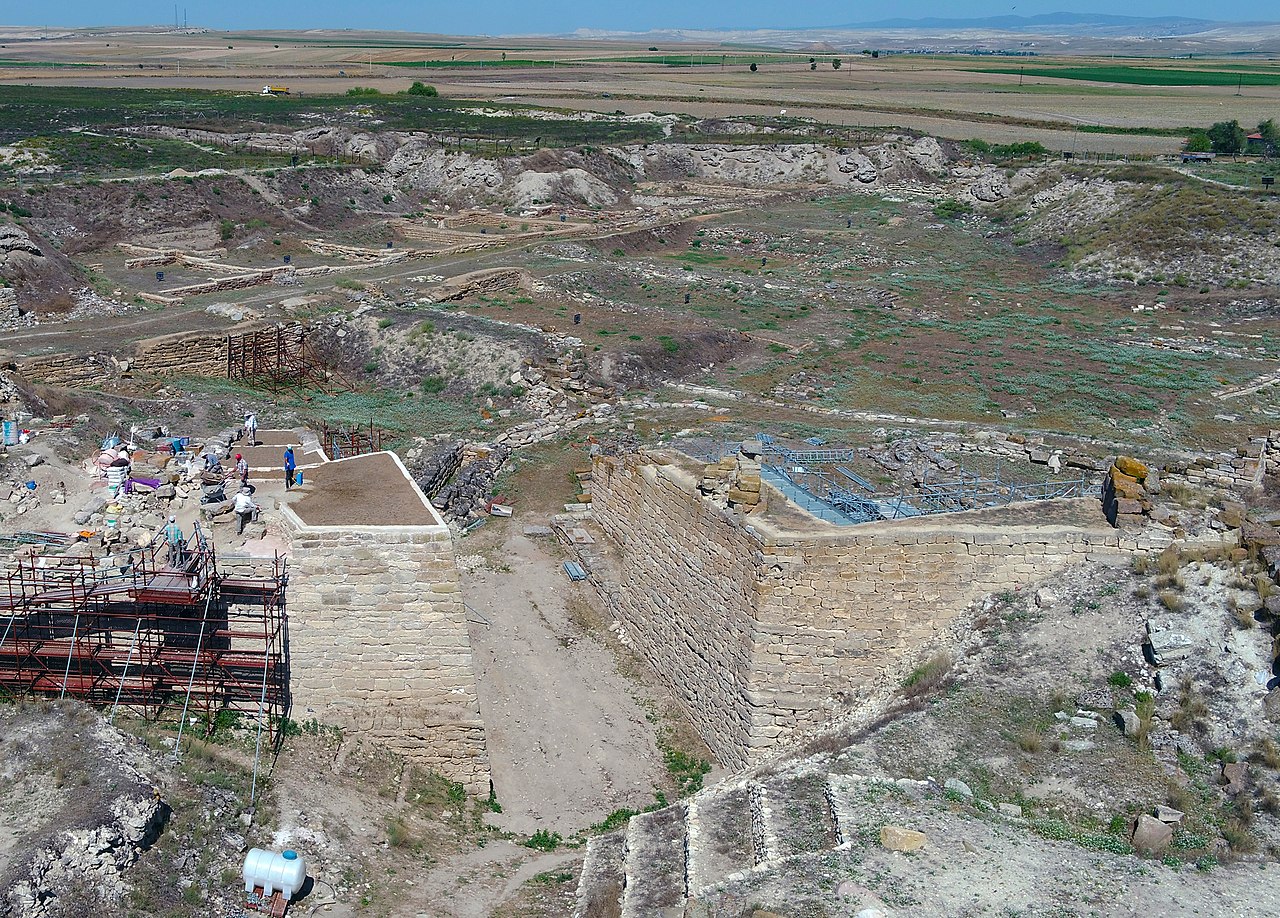
Hattusha is a marvel of urban planning and defensive architecture. Its walls, punctuated by monumental gates like the Lion Gate and the Sphinx Gate, snake over 6 kilometers across rocky terrain. Within lay a vast city of temples, palaces, and archives. The Great Temple (Temple 1), dedicated to the storm god Tarhunt and the sun goddess Arinna, was a sprawling complex with storerooms that could hold enough grain to feed thousands, a testament to the state’s economic control. But the true soul of Hittite religion, and a key to understanding their worldview, lies just over a mile northeast of the city at Yazılıkaya.

Lion Gate, Hattusa 06 | Bernard Gagnon (CC BY-SA 3.0)
The Rock-Cut Pantheon: Yazılıkaya
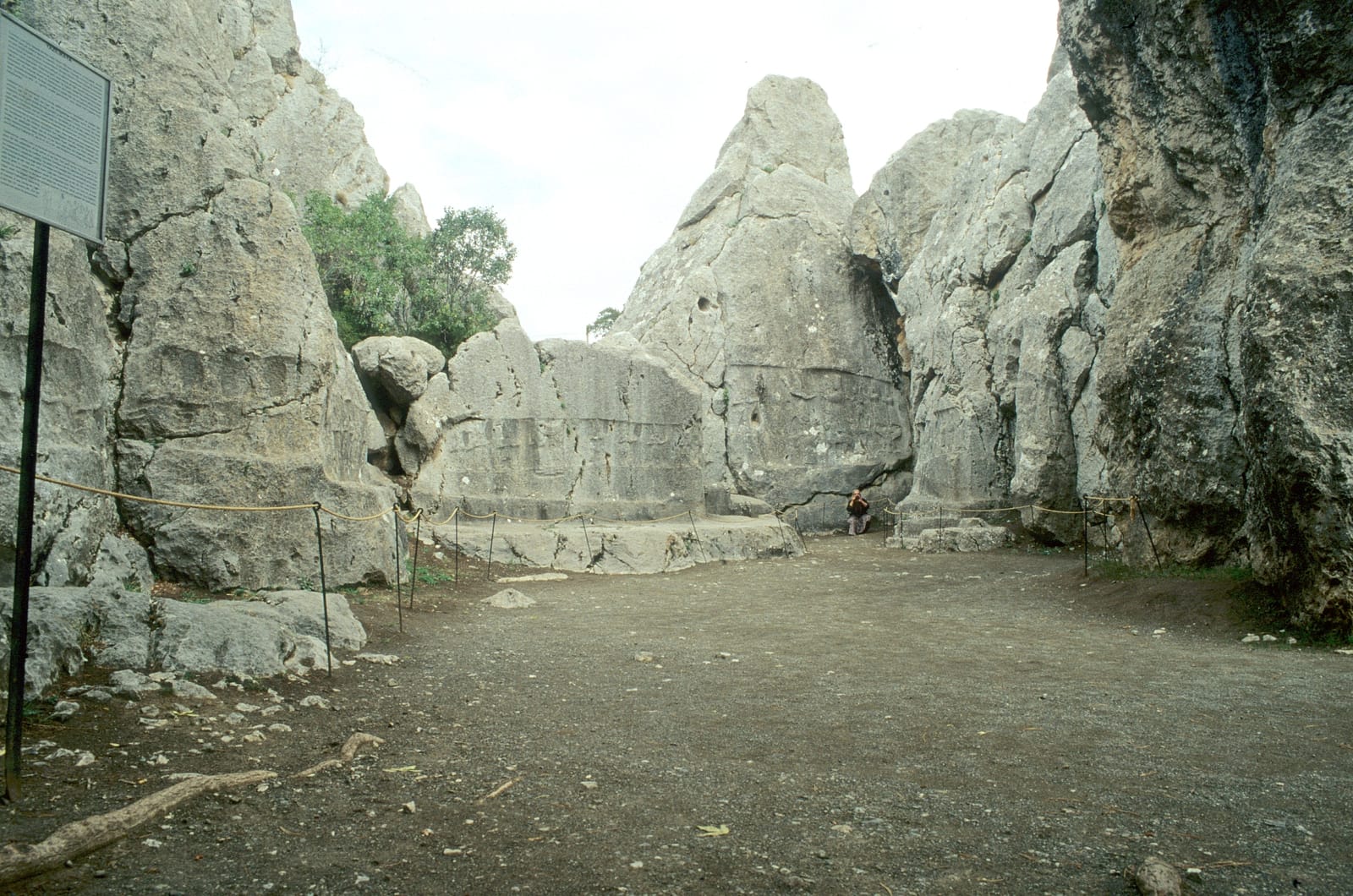
Yazılıkaya, meaning "Inscribed Rock," is an open-air sanctuary where the bedrock has been carved into two natural gallery chambers. This is the most breathtaking visual document of the Hittite pantheon. Processions of deities, men and women carved in exquisite relief, march towards a central scene. In Chamber A, two converging processions meet. On one side, male gods wearing pointed hats and carrying curved swords or maces. On the other, goddesses in long skirts and cylindrical headdresses. They all converge upon the main scene: the embrace of the supreme storm god, Tarhunt, and the sun goddess, Hebat** (adopted from the Hurrian pantheon in the empire’s later phase).
In the smaller Chamber B, a striking, well-preserved relief depicts King **Tudhaliya IV (c. 1237–1209 BCE) embraced by his patron god, Sharruma. Here, the divine and the royal are inextricably linked. The king is not just a mediator with the gods; he is under their direct protection, his legitimacy carved in stone for eternity. Yazılıkaya was likely the site of critical New Year festivals, where the cosmic order was reaffirmed and the king’s sacred role was performed before the assembled court and the gods themselves.

Relief of Tudhaliya IV (Yazilikaya) | https://www.flickr.com/photos/travellingrunes/ (CC BY-SA 2.0)
The Age of Empire: Diplomacy, Conquest, and Clash of Titans
From their Anatolian heartland, the Hittite kings of the New Kingdom period (c. 1400–1200 BCE) expanded aggressively. They subdued rival kingdoms in western Anatolia like Arzawa and turned their gaze south, toward the rich lands of Syria, bringing them into direct conflict with Egypt, the other superpower of the age.
The apex of this power came under Suppiluliuma I (c. 1344–1322 BCE), a master strategist. He exploited Egyptian weakness following the death of Pharaoh Tutankhamun, launching campaigns into Syria and capturing the vital city of Carchemish. His dynasty solidified control. But the most famous encounter between Hatti and Egypt was not a decisive victory for either, but a costly stalemate.
In 1274 BCE, the massive armies of King Muwatalli II and Pharaoh Ramesses II met at Kadesh in Syria. Ramesses’ grandious accounts on his temple walls at Abu Simbel claim a great victory, but the historical reality was a near-disaster for the Egyptians, saved only by last-minute reinforcements. The battle ended in a draw. Its true significance, however, lies in its aftermath. Sixteen years later, in 1259 BCE, Muwatalli’s brother and successor, Hattusili III, and Ramesses II concluded the Egyptian-Hittite peace treaty. Copies in Egyptian hieroglyphs and Hittite cuneiform have been found at Karnak and Hattusha. It is the oldest surviving written peace treaty in the world, a document of non-aggression, mutual defense, and extradition. It was sealed by the marriage of Ramesses to a Hittite princess. Diplomacy had triumphed over continued war.
The Western Frontier: Troy, Wilusa, and the Ahhiyawa Question
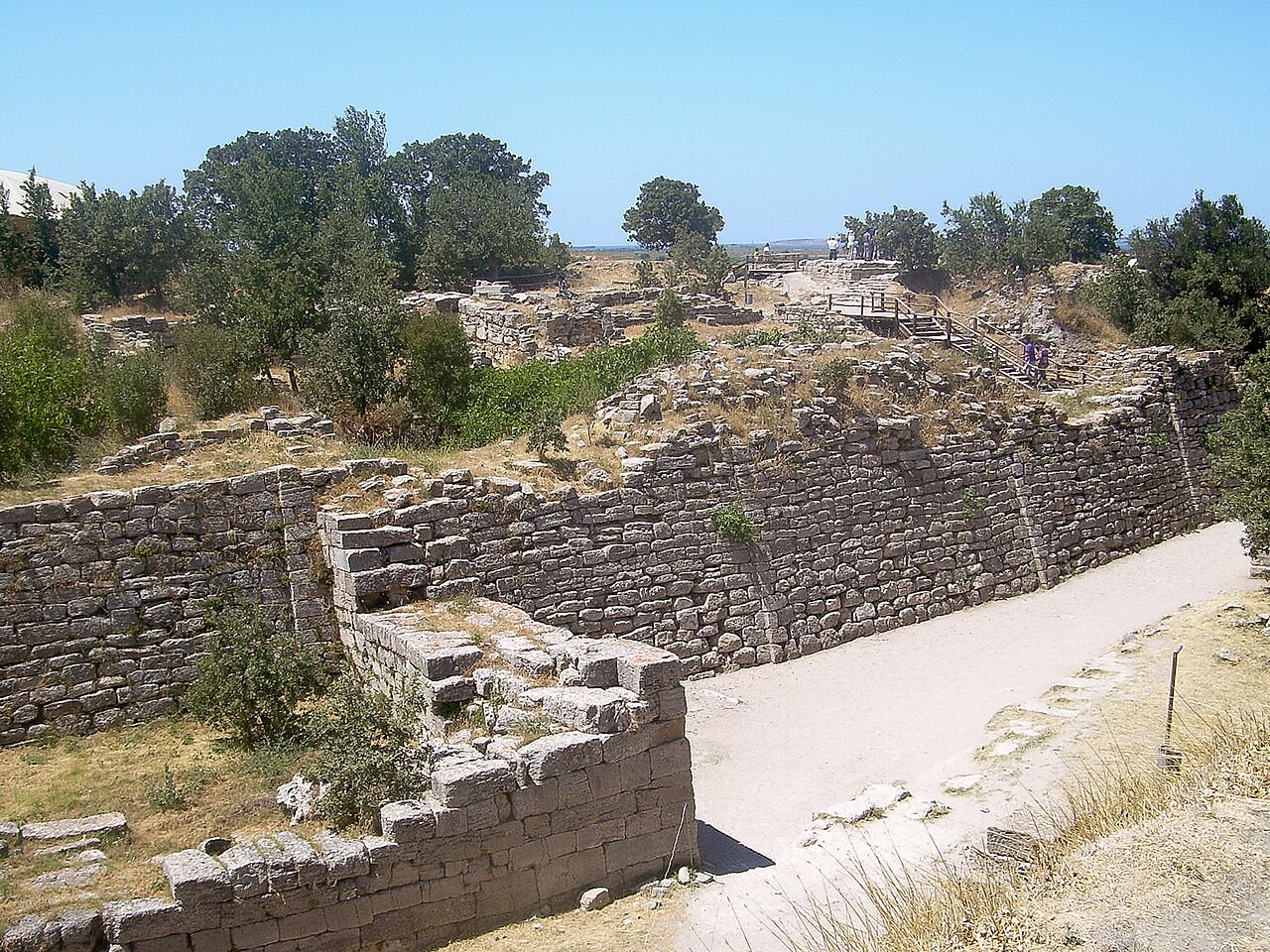
The Hittite Empire’s western frontier was a complex patchwork of vassal states and rival powers. Hittite texts refer to a land called Wilusa, located in northwest Anatolia. Decades of scholarly detective work, cross-referencing Hittite correspondence with geographical data, have led to a powerful consensus: Wilusa is almost certainly the Hittite name for Ilios, or Troy**.
Tablets from Hattusha detail treaties and conflicts with Wilusa’s kings, such as Alaksandu of Wilusa (a name intriguingly similar to "Alexander," an alternative name for Paris in Homer’s Iliad). They also speak of a persistent, often hostile, seafaring kingdom across the Aegean called **Ahhiyawa, widely identified with the Mycenaean Greek world. The Hittites complained of Ahhiyawan interference in their Anatolian vassal states. The archaeological record at Troy (Levels VI and VIIa) reveals a wealthy, fortified citadel controlling the Dardanelles in the Late Bronze Age — exactly the period of Hittite records. It was a key player in regional power politics, likely a Hittite vassal at times, and a target for Mycenaean (Ahhiyawan) aggression. The Hittite archives provide the geopolitical backdrop to the legendary Trojan War, transforming Homer’s epic from myth into a reflection of a genuine historical struggle for control of a vital waterway.
The Lightning Collapse and Scattered Embers
Around 1200 BCE, the stable, interconnected world of the Late Bronze Age disintegrated with shocking speed. The Hittite Empire collapsed utterly. Hattusha was violently destroyed, its palaces and temples burned. The central state apparatus vanished. The causes were a "perfect storm" of calamities: prolonged drought and famine evidenced in tree-ring data; internal rebellions perhaps fueled by these hardships; and the relentless pressure of migratory groups the Egyptians called the "Sea Peoples," who swept through Anatolia and the Levant, toppling kingdoms.
But the Hittite story did not end in 1200 BCE. In the ensuing vacuum, smaller, Neo-Hittite (or Syro-Hittite) city-states emerged in southeastern Anatolia and northern Syria, carrying on Hittite artistic, religious, and linguistic traditions for another 500 years. Karatepe-Aslantaş, built in the 8th century BCE by King Azatiwada of the kingdom of Que, is a magnificent example. This open-air museum features monumental gates adorned with vibrant reliefs of gods, feasts, and hunting scenes. Its crowning significance is the Karatepe Bilingual, inscriptions in Phoenician and Hieroglyphic Luwian (a descendant of Hittite hieroglyphs) that were the final key to deciphering the Hittite hieroglyphic script.
Further north, at Gordion, the capital of Phrygia, we see the legacy of the Hittite collapse in a different way. The Phrygians, likely migrants from the Balkans, filled the power vacuum on the Anatolian plateau. In the magnificent Tumulus MM** (likely the tomb of the legendary King Midas, c. 740 BCE), the material culture is distinctly Phrygian, yet it sits in a landscape once dominated by Hattusha. The Phrygians were both successors and inheritors, their powerful kingdom rising from the ashes of the Hittite heartland.
Epilogue: The Hittite Legacy in Stone and Story
The journey from Hattusha to Troy is more than a geographical path across Anatolia; it is a narrative arc of one of history’s most formidable yet forgotten empires. The Hittites were pioneers of constitutional monarchy, with the Pankush council holding real power to check the king. They were masters of law, their code often more humane and restitution-based than Hammurabi’s. They were pragmatic diplomats, as the Treaty of Kadesh proves. And they were devout synthesizers, weaving the gods of the conquered into their own ever-expanding pantheon.
Their rediscovery rewrote history. The lonely ruins at Boğazkale, the silent processions at Yazılıkaya, the gold of Alacahöyük, the bilingual inscriptions at Karatepe, the layered citadel of Troy, and the Phrygian mounds at Gordion are not isolated sites. They are chapters in a single, epic story. They tell of an empire that forged order from the Anatolian plateau, stood toe-to-toe with Pharaohs, shaped the destiny of legendary Troy, and left a cultural legacy that endured long after its capital’s walls had crumbled. The Hittites remind us that history is a palimpsest, and that even the mightiest empires can vanish, only to await the curious spade and the deciphering mind to tell their tale once more.